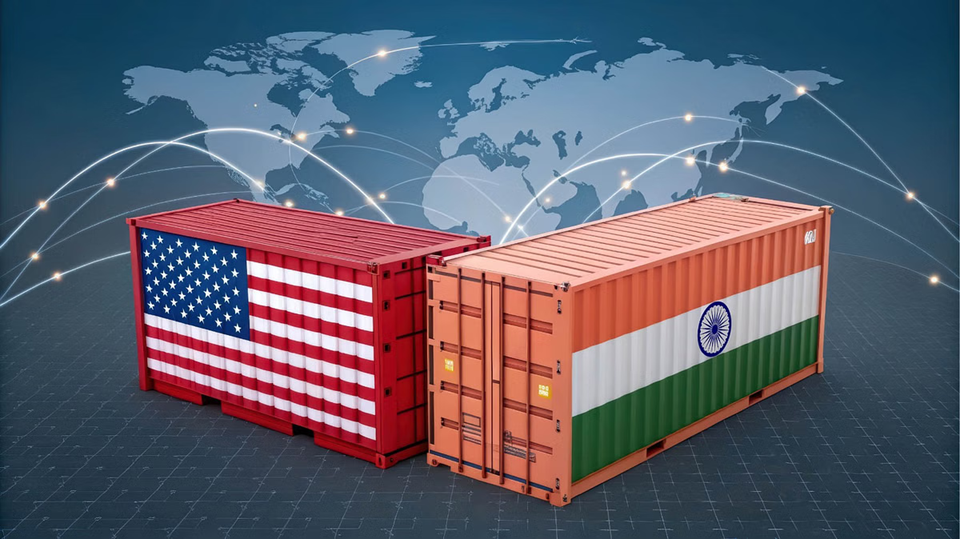



A Premeditated Economic Warfare Masquerading as Trade Policy
The implementation of punitive 50% tariffs on Indian goods by the Trump administration represents an unprecedented escalation of economic coercion that exposes the profound contradictions and hypocritical machinations of American foreign policy. This egregious act of economic warfare, ostensibly justified by India’s sovereign energy procurement decisions, constitutes nothing less than an attempt to subjugate one of the world’s largest democracies through the weaponization of international commerce.
The chronology of events reveals a calculated campaign of intimidation designed to compel Indian capitulation to American hegemonic demands. Beginning with inflammatory rhetoric labeling India a “tariff king” and subsequently escalating to the current draconian measures, the Trump administration has systematically demolished two decades of painstakingly constructed bilateral relations. This represents not merely a trade dispute, but a fundamental assault on the principles of sovereign equality and mutual respect that underpin civilized international discourse.
The Architecture of Economic Coercion and Its Devastating Ramifications
The magnitude of economic devastation threatened by these punitive measures cannot be overstated. With India’s exports to the United States valued at approximately $87 billion annually, representing nearly 2% of the nation’s GDP, the imposition of 50% tariffs threatens to eviscerate entire industrial sectors. Bloomberg Economics estimates that this protectionist assault could reduce India’s outbound shipments to the United States by up to 60%, potentially obliterating $52 billion in trade and devastating the livelihoods of millions of Indian workers.
The sectors most vulnerable to this economic aggression include textiles, gems and jewelry, automotive components, seafood, and leather goods—industries that collectively employ millions of Indians and represent the backbone of the nation’s manufacturing prowess. The Global Trade Research Initiative warns that these tariffs could render Indian exports to the United States “economically unviable,” effectively constituting a trade embargo against one of America’s purported strategic partners. l contraction of up to 1.2 percentage points in India’s GDP growth. This represents a deliberate attempt to throttle the economic aspirations of 1.4 billion people, undermining India’s trajectory as one of the world’s fastest-growing major economies and relegating it to a position of subservience to American economic dictates.
Exposing the Profound Hypocrisy of American Trade Policy
Perhaps most damning is the breathtaking hypocrisy that underlies this economic assault. While sanctimoniously condemning India for its energy procurement from Russia, the United States itself continues to import billions of dollars worth of Russian commodities, including $1.27 billion in fertilizers, $624 million in uranium and plutonium, and $878 million in palladium in 2024 alone. When confronted with this glaring contradiction, President Trump disingenuously claimed ignorance, declaring “I don’t know anything about it” despite overwhelming evidence of continued American-Russian commercial engagement.
This selective moral outrage becomes even more egregious when one considers that it was American officials who initially encouraged India to purchase Russian oil to stabilize global energy markets. Former U.S. Ambassador to India Eric Garcetti explicitly acknowledged that India “bought Russian oil because we wanted somebody to buy Russian oil at a price cap,” exposing the duplicitous nature of current American condemnation. The reversal of this policy represents nothing less than a betrayal of previous American assurances and a fundamental violation of good faith in international relations.
Furthermore, the discriminatory nature of these tariffs becomes apparent when examining the differential treatment accorded to other nations. While China—the world’s largest purchaser of Russian oil with imports valued at $62.6 billion in 2024 compared to India’s $52.7 billion—receives a 90-day reprieve and more favorable treatment, India faces immediate and severe punishment. This selective enforcement reveals the true nature of American policy: not principled opposition to Russian energy purchases, but calculated economic coercion designed to extract maximum concessions from perceived vulnerable partners.
The Weaponization of Trade: A Dangerous Precedent for Global Commerce
The Trump administration’s approach represents a fundamental perversion of international trade law and established commercial practices. By invoking the International Emergency Economic Powers Act (IEEPA) to justify tariffs based on specious national security claims, the United States is establishing a precedent that threatens to undermine the entire architecture of rules-based international trade. This represents what scholars have characterized as the “weaponization of everything,” transforming legitimate trade instruments into tools of political coercion.
The Center for Strategic and International Studies warns that such misuse of economic statecraft tools will “build resistance to U.S. coercive tools and make the U.S. economy more vulnerable to economic coercion” while significantly harming American credibility abroad. The systematic abuse of tariff authority for non-economic objectives represents a radical departure from established norms and threatens to precipitate a global race to the bottom in trade relations.
This economic aggression extends far beyond bilateral trade considerations to encompass a broader assault on the multilateral trading system. By abandoning the World Trade Organization’s established procedures and imposing unilateral punitive measures, the United States is effectively declaring its withdrawal from the rules-based international order that it once championed.
The Geopolitical Implications of Economic Bullying
The Trump administration’s coercive tactics reveal a profound misunderstanding of contemporary geopolitical realities and India’s strategic importance. At a time when the United States purports to view India as a crucial partner in countering Chinese influence, the imposition of punitive tariffs threatens to drive New Delhi directly into Beijing’s embrace. This strategic myopia represents a catastrophic miscalculation that could fundamentally realign global power structures to America’s detriment.
Expert analysis suggests that these actions constitute “a slow-motion catastrophe” that risks dismantling the painstakingly constructed U.S.-India strategic partnership. The politicization of bilateral relations, combined with the administration’s embrace of Pakistan and threats against India’s membership in multilateral organizations like BRICS, signals a fundamental realignment that could isolate the United States and strengthen alternative power centers.
The timing of these measures is particularly revealing, coming immediately after Trump’s engagement with Pakistani military leadership and his offer of more favorable trade terms to Islamabad. This juxtaposition exposes the administration’s complete abandonment of strategic coherence in favor of transactional opportunism that prioritizes short-term tactical advantages over long-term strategic interests.
The Domestic American Cost of Trade Warfare
What remains deliberately obscured in the administration’s rhetoric is the substantial cost that these tariffs will impose on American consumers and businesses. Despite Trump’s mendacious claims that “India will be paying” these tariffs, the economic reality is that American importers and consumers will bear the primary burden of these protectionist measures. Research by the Tax Foundation and other institutions demonstrates that tariffs function as regressive taxes that disproportionately impact lower-income American families, potentially resulting in an average annual income loss of $2,400 per household.
The inflationary pressures generated by these tariffs will compound existing economic challenges facing American families, while simultaneously disrupting established supply chains and forcing American businesses to seek more expensive alternatives. This represents a deliberate policy choice to impose economic hardship on American consumers in service of the administration’s protectionist ideology and political grandstanding.
India’s Principled Response to Economic Coercion
In stark contrast to the American administration’s inflammatory rhetoric and coercive tactics, India’s response has been measured, principled, and grounded in established international law. New Delhi’s characterization of the tariffs as “unfair, unjustified and unreasonable” reflects not merely diplomatic protest but a fundamental assertion of sovereign rights in the face of economic intimidation.
India’s emphasis on its responsibility to ensure “energy security of 1.4 billion people” exposes the moral bankruptcy of American demands that a developing nation sacrifice the welfare of its population to serve American geopolitical objectives. The government’s commitment to “take all actions necessary to protect its national interests” represents a principled defense of sovereignty against external coercion.
The Indian response has also effectively highlighted the discriminatory nature of American policy by noting that “several other countries are also taking” similar actions “in their own national interest”. This measured approach contrasts favorably with the American administration’s bellicose rhetoric and demonstrates India’s commitment to rational discourse even in the face of economic aggression.
The Erosion of American Soft Power and Global Leadership
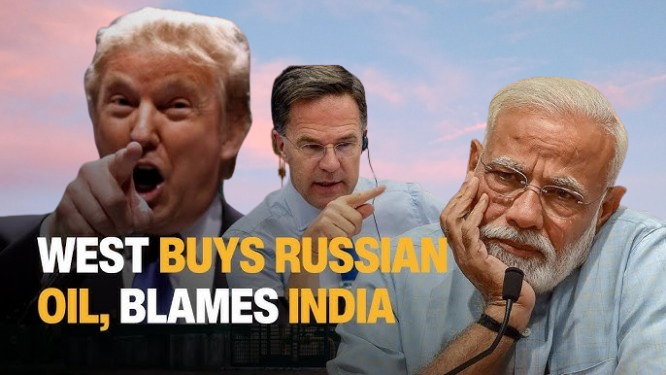 The implementation of these punitive tariffs represents a catastrophic erosion of American soft power and moral authority on the global stage. The transformation of the United States from a champion of free trade and multilateral cooperation into a practitioner of economic coercion and unilateral diktat signals a fundamental retreat from global leadership. This regression threatens to accelerate the emergence of alternative power centers and multilateral institutions that explicitly exclude American participation.
The damage to American credibility extends far beyond immediate trade considerations to encompass broader questions of reliability and trustworthiness as a partner. If the United States can capriciously abandon established partnerships and impose punitive measures on democratic allies, what confidence can any nation have in American commitments or assurances?
The Trump administration’s approach represents what scholars have characterized as “America’s First Contradiction-in-Chief,” revealing the fundamental incompatibility between proclaimed American values and actual policy implementation. This cognitive dissonance undermines American moral authority and accelerates the global search for alternatives to American leadership.
Economic Analysis: The Futility of Protectionist Measures
Economic analysis demonstrates the fundamental futility of the Trump administration’s protectionist approach to addressing trade imbalances. The current U.S. trade deficit with India of approximately $45.8 billion represents less than 5% of America’s total trade deficit, making it a peripheral factor in overall trade dynamics. Moreover, much of this deficit reflects American consumer preferences for Indian goods and services, rather than unfair trade practices that warrant punitive response.
The attempt to address complex macroeconomic imbalances through crude protectionist measures ignores the underlying structural factors that drive trade patterns. The U.S. trade deficit primarily reflects America’s low domestic savings rate and high consumption patterns—factors that cannot be addressed through tariff policy but require fundamental changes to fiscal and monetary policies.
Furthermore, the imposition of tariffs on Indian goods will likely result in trade diversion rather than trade creation, forcing American consumers to purchase more expensive alternatives from other suppliers while failing to address underlying competitive disadvantages in American manufacturing.
The Path Forward: Principled Resistance to Economic Coercion
India’s response to this economic aggression must remain rooted in principled defense of sovereignty while exploring opportunities for strategic diversification. The government’s emphasis on seeking alternative markets in Europe, Asia, Africa, and Latin America represents a pragmatic approach to reducing dependence on American markets while maintaining commitment to global integration.
The current crisis presents an opportunity for India to accelerate economic reforms that enhance competitiveness and reduce structural vulnerabilities. Investment in logistics infrastructure, digitalization of customs procedures, and enhancement of export capabilities can strengthen India’s resilience to external economic pressures while positioning the nation for long-term growth.
India must also leverage its position within multilateral institutions like BRICS, the Shanghai Cooperation Organization, and other emerging forums to build alternative trading relationships that reduce dependence on American markets. The development of alternative payment systems, trade financing mechanisms, and supply chain networks can provide greater strategic autonomy while maintaining global integration.
Conclusion: The Imperative of Principled Resistance
The Trump administration’s imposition of punitive tariffs on India represents far more than a trade dispute—it constitutes a fundamental challenge to the principles of sovereign equality, mutual respect, and rules-based international order. The breathtaking hypocrisy, discriminatory implementation, and coercive intent underlying these measures expose the bankruptcy of American claims to moral leadership and the urgent necessity for alternative approaches to global governance.
India’s principled response to this economic aggression demonstrates the possibility of maintaining dignity and sovereignty in the face of hegemonic pressure. By refusing to capitulate to American demands while remaining committed to rational dialogue and multilateral engagement, India is setting a precedent that other nations can follow in resisting economic coercion.
The ultimate irony of the Trump administration’s approach is that it will likely accelerate the very trends it purports to combat—the emergence of alternative power centers, the development of parallel economic institutions, and the erosion of American influence on the global stage. By abandoning the soft power advantages that once made American leadership attractive, the United States is ensuring its own strategic marginalization.
The current crisis thus represents not merely a challenge to Indian interests, but a defining moment for the future of international relations. The choice between capitulation to economic coercion and principled defense of sovereignty will determine whether the emerging multipolar order is characterized by mutual respect or hegemonic domination. India’s response will serve as a beacon for other nations facing similar pressures and demonstrate that economic bullying, however sophisticated, cannot ultimately triumph over principled resistance and strategic patience.