



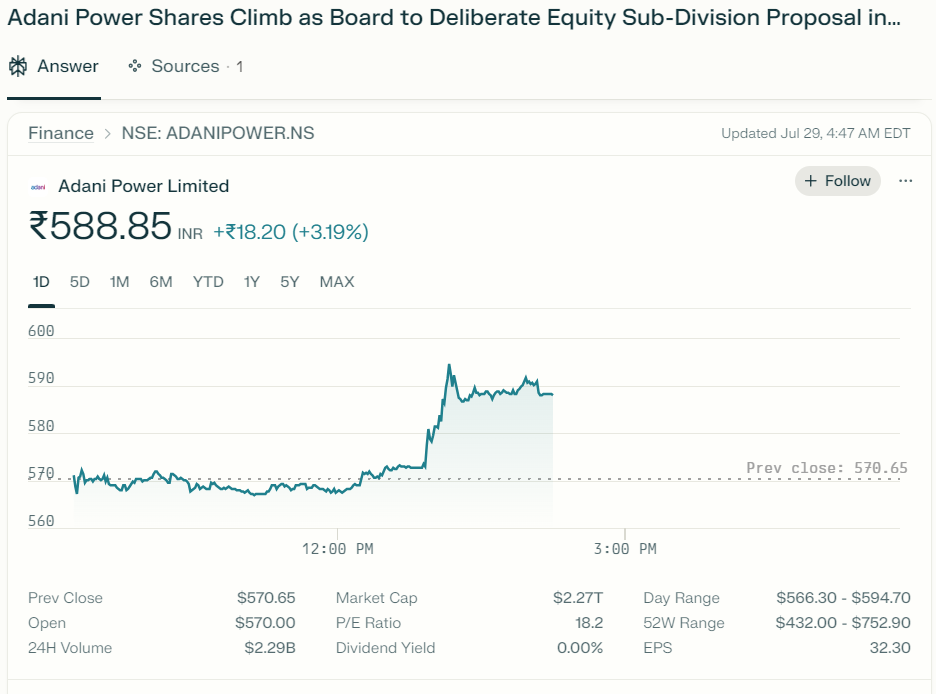
Adani Power Ltd., a leading player in India’s power sector and a flagship entity within the diversified Adani Group, witnessed a significant surge in its share price on Tuesday afternoon, July 29, 2025, with shares climbing 3.45% to ₹590.30 on the Bombay Stock Exchange (BSE), compared to the previous closing value of ₹570.60. This positive momentum catapulted the company’s market capitalization to an impressive ₹2.26 lakh crore.
This share price rally was ignited by the company’s announcement concerning a forthcoming meeting of its Board of Directors, scheduled for Friday, August 1, 2025. The principal agenda of this high-profile meeting is to deliberate an equity share sub-division (stock split), a move which, if executed, stands to reshape Adani Power’s share capital structure significantly. The board meeting on that day will also see the company unveiling its quarterly financial results, covering the period through June 2025.
Understanding Stock Splits: Context and Rationale
A stock split is a corporate action in which a company divides its existing shares into multiple shares, thereby reducing the face value of each share. For Adani Power, the current proposal is to split shares of ₹10 face value each into a lower denomination, a move contingent upon further deliberation by the Board, as well as requisite shareholder, statutory, and regulatory approvals.
Objectives of Stock Splits:
-
Enhance Liquidity: By increasing the number of shares in circulation and lowering the price per share, stock splits can improve liquidity, making it easier for a broader spectrum of investors—including retail investors—to participate.
-
Perceived Affordability: Shares trading at a lower price post-split are often seen as more affordable, attracting participation from investors who may have found the higher-priced shares cost-prohibitive.
-
Widen Shareholder Base: Companies often undertake splits to encourage wider ownership, broadening their retail investor base.
-
Signaling Mechanism: While a split has no intrinsic impact on the company’s market capitalization or underlying value, such corporate actions can signal management’s confidence in the company’s prospects and catalyze positive sentiment.
Details of the Proposed Board Meeting
Adani Power’s board meeting, scheduled for August 1, 2025, will feature deliberations on the following key agenda items:
-
Proposal to alter the company’s share capital by way of a sub-division/split of existing equity shares of ₹10 each, fully paid-up, into lower denominations.
-
Determination of the ratio and specifics regarding the split, which remain at the board’s discretion.
-
Contingencies: The plan will be subject to shareholder consent and all necessary statutory and regulatory approvals, consistent with Indian corporate governance and securities market regulations.
-
Release of the company’s financial results for the quarter ended June 2025.
Sample Board Disclosure:
“We wish to inform that the Board meeting to be held on August 1, 2025, shall, inter alia, consider a proposal for alteration in the share capital of the Company by way of sub-division/split of the existing equity shares of the face value ₹10 each, fully paid-up, in such manner as may be determined by the Board, subject to requisite shareholder and regulatory approvals under applicable law.”
Market Reaction: Trading Volumes and Investor Sentiment
Tuesday’s trading session was marked by heightened investor interest in Adani Power shares, as reflected in substantial trading volumes. Approximately 1.61 lakh shares exchanged hands, accounting for a turnover of ₹9.21 crore on the BSE. This surge in trading activity underscores the excitement among both institutional and retail investors striving to position themselves ahead of the anticipated corporate action.
Market participants generally interpret such announcements as positive, as stock splits are often associated with strong operational performance and management’s optimism regarding future prospects.
The Financial and Strategic Impact of a Stock Split
1. Impact on Shareholders
-
Portfolio Adjustment: Post-split, the total holding value for existing shareholders remains unchanged, but the number of shares they own increases in accordance with the split ratio. For example, in a 1:5 split, every one share of ₹10 face value becomes five shares of ₹2 face value.
-
No Immediate Wealth Creation: While the nominal price per share drops, the total market value held by investors does not change at the time of the split.
-
Improved Accessibility: With a reduced price per share, Adani Power shares become more accessible to small investors.
2. Impact on Market Liquidity
-
Increased Trading Activity: Lower share prices post-split tend to increase trading volumes, since more investors can afford to participate.
-
Narrower Bid-Ask Spreads: Enhanced liquidity can lead to narrower bid-ask spreads, reducing transaction costs for trading participants.
3. Strategic Corporate Implications
-
Investor Base Expansion: Stock splits generally attract retail interest, leading to a broader, more diverse shareholder base.
-
Enhanced Perception: Frequent splits are often perceived as a marker of consistent performance and a confident outlook from management.
-
No Change to Fundamentals: It is crucial for investors to recognize that stock splits do not alter the company’s fundamental financial position, profitability, or business outlook.
Regulatory and Shareholder Approval: The Compliance Process
Any proposal for a stock split must undergo a rigorous approval process, including:
-
Board Approval: Initial consideration and decision by the Board of Directors.
-
Shareholder Approval: A majority vote at a general meeting, adhering to the provisions of the Companies Act, 2013, and SEBI (Securities and Exchange Board of India) regulations.
-
Statutory and Regulatory Clearances: Compliance with various regulatory bodies and stock exchanges to ensure transparent and fair execution of the split.
This multi-layered approval framework is designed to safeguard the interests of all stakeholders, including minority shareholders, and to ensure adherence to established governance standards.
Adani Power’s Recent Performance: Setting the Stage for the Split
1. Market Performance
Over the past year, Adani Power has posted robust performance metrics, buoyed by:
-
Rising electricity demand in India
-
Operational improvements and cost efficiencies
-
Expansion of generation capacity
-
Deleveraging and balance sheet strengthening
These factors have contributed to a sustained uptrend in the company’s share price and overall market capitalization.
2. Investor Perception and Sectoral Context
The announcement comes at a time when the broader Adani Group has recovered significant market value following a turbulent period post-2023, regaining investor confidence with a blend of strong operational performance and regulatory clearances.
India’s power sector—particularly thermal and renewable energy players—has benefited from a sustained push towards infrastructure growth, energy transition, and increased electrification, creating a conducive environment for sector leaders like Adani Power.
What’s Next? The Road Ahead for Adani Power
-
Board Meeting Outcomes (August 1, 2025):
-
Exact split ratio and modalities to be decided and disclosed post-meeting
-
Announcement of financial results for the quarter ending June 2025
-
-
Formal Approvals:
-
Shareholder meeting notice, voting process, and announcements
-
Clearances from exchanges and regulatory authorities
-
-
Record Date and Implementation:
-
Once approved, the company will fix a “record date,” which determines the shareholders eligible for the split
-
Shares will begin trading ex-split following implementation, and new split-adjusted shares are credited to eligible demat accounts
-
-
Continued Surveillance by Investors:
-
Investors and analysts will observe subsequent stock price movement, liquidity changes, and any valuation impact
-
Watch for broader sectoral trends and Adani Power’s operational performance as disclosed in earnings statements
-
Risks and Considerations
While a stock split often signals management’s optimism and can galvanize positive sentiment, it is important to remain cognizant of certain risks and limitations:
-
No Fundamental Value Addition: Share splits do not boost underlying profitability or cash flows.
-
Speculative Trading: Increased trading activity post-split may lead to short-term volatility or speculative trading.
-
External Factors: Macro-economic, regulatory, or sector-specific developments could still impact the stock, regardless of the split.
The Investor Takeaway
Adani Power’s consideration of a stock split mirrors a time-tested strategy for enhancing market participation, liquidity, and broadening its investor base, especially as its market value continues its upward trajectory. For existing shareholders, there is no change in underlying value, though increased attention and enhanced liquidity could translate into improved price discovery over time.
Nevertheless, as with all investment decisions, prospective and current investors are best served by focusing on the company’s financials, sector outlook, and management commentary, rather than being swayed solely by corporate actions such as stock splits. This is explicitly underscored by the standard disclaimer reminding readers to consult certified financial advisors prior to making any investment decisions.
Conclusion
Adani Power’s board meeting on August 1, 2025, stands to be a landmark event for the company’s shareholders and the Indian equity market at large. A potential stock split, aligned with a strong performance track record and a favorable growth outlook for India’s power sector, marks yet another pivotal chapter in Adani Power’s journey. The eyes of the investing public and analysts will be squarely trained on the company’s announcements in the coming days, awaiting clarity on the split ratio, rationale, and its anticipated market impact.
With well-structured corporate governance processes and robust performance, Adani Power’s actions remain emblematic of the dynamic and rapidly evolving Indian infrastructure sector. Nonetheless, prudent investment choices should always be anchored in a holistic analysis, grounded in both fundamental and technical factors.
Disclaimer: This analysis is intended solely for informational purposes. It is not investment advice. Please consult qualified financial advisors before making investment decisions.